
Trees
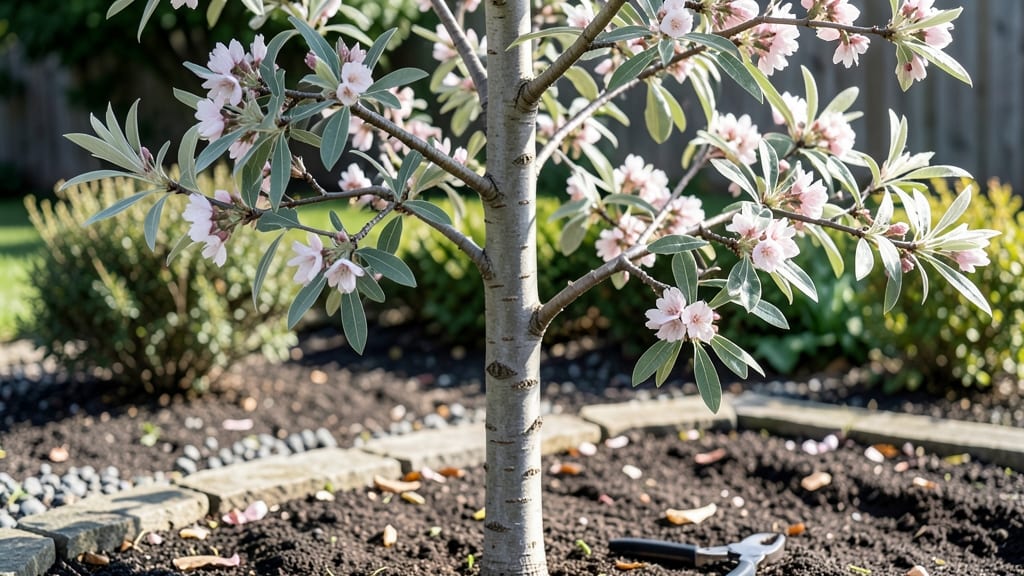
What does an almond tree look like—it stands out with its graceful height, often reaching 15 to 30 feet, and striking silvery-green foliage that shimmers in sunlight. 🌿 refined, almost tropical appearance.
Unlike many trees, almonds bloom before their leaves appear, with delicate pink or white flowers in early spring that create a breathtaking display.
Its bark is smooth and gray when young, developing a rougher texture as it matures, while the branches grow in a vase-like shape, making it an ideal focal point in any landscape.
The tree’s silvery leaves and fragrant blossoms make it a standout choice for Mediterranean-style gardens or as a specimen tree in larger yards. Pair it with lavender, rosemary, or other drought-tolerant plants to enhance its natural beauty.
When it comes to fruit, almond trees produce oval-shaped nuts encased in a woody shell, but the real showstopper is the tree’s year-round appeal—from spring blooms to autumn’s golden foliage.
Its elegant form and low-maintenance nature make it perfect for both urban and rural settings, whether as a standalone feature or part of a larger orchard.
For gardeners planning around almond trees, consider their sunlight needs (full sun for best growth) and spacious roots (they need room to spread). Their striking silhouette and seasonal interest ensure they’ll be the centerpiece of any outdoor space for decades to come.
📚 In This Guide
- What you need
- Instructions
- Tips and common mistakes
- Wrapping up and next steps
What you need
- ● Reference images or guidebook: A printed or digital guide (e.g., National Audubon Society Field Guide to North American Trees) to compare features.
- ○ Magnifying glass (optional): For closely inspecting bark texture, leaf veins, or flower buds.
- ● Notebook & pen: To jot down observations like leaf shape, tree height, or flowering time.
- ● Smartphone with camera: To capture photos of leaves, flowers, or bark for later comparison.
- ● Weather-appropriate clothing: Comfortable shoes, hat, and sunscreen for outdoor scouting.
- ● Almond tree sapling: Non-bearing variety (e.g., Nonpareil, Butte) for home gardens.
- ● Bearing variety (if pollination partners are available).
- ● Quantity: 1 tree (or 2+ for cross-pollination).
- ● Planting location: Full sun (6+ hours daily).
- ● Well-draining soil (sandy loam ideal).
- ● Space: 15–20 feet between trees (or 25+ feet for full growth).
- ● Tools: Shovel or trowel (for digging).
- ● Garden hose (for watering).
- ● Mulch (2–4 inches of wood chips or straw).
- ● Pruning shears (for shaping young trees).
- ○ Optional (but helpful): Soil pH tester (aim for 6.0–7.5).
- ● Fertilizer (balanced 10-10-10 or citrus-specific).
- ● Drip irrigation system (for consistent watering).
How to identify an almond tree by its distinctive features
Recognizing an almond tree comes down to its signature traits—height, bark, leaves, and seasonal changes.
🌿 Step 1: Observe the Tree’s Height and Growth Habit
Almond trees (Prunus dulcis) typically reach 15-30 feet at maturity, though dwarf varieties stay under 10 feet. They grow upright with a rounded canopy that spreads wider than it grows tall, especially in mature specimens. The branches are sturdy but flexible, often bearing spiny twigs—a key distinguishing feature that sets them apart from fruit trees like peaches or plums.
Young trees have a single, strong trunk that may fork early, while older trees develop a multi-trunk appearance from suckers or pruning. The bark is smooth and grayish when young, developing longitudinal fissures as it ages. Look for horizontal branching—a hallmark of almond trees—where limbs grow outward rather than upward.
🌱 Step 2: Examine the Leaves for Silvery Characteristics
The most striking identifier is the silvery-gray underside of the leaves, caused by fine, downy hairs. The upper surface is dark green and slightly rough to the touch. Leaves are oval-shaped, 1-3 inches long, and have a slightly serrated edge. They emerge late in spring (after blooms) and stay on the tree until late fall, turning yellow-brown before dropping.
Here’s the trick: Hold a leaf up to light. The silvery sheen on the underside is unmistakable and distinguishes almonds from similar stone fruits like apricots or cherries, which lack this trait. If you see clustered buds along the branches, that’s another clue—almonds grow in short, dense clusters rather than solitary buds.
⏰ Step 3: Identify Flowers and Fruit Clusters
Almond trees bloom earlier than most fruit trees, often in late winter or early spring (February–March in most climates). The flowers are pinkish-white, 5-petaled, and ½-inch wide, appearing in small clusters before the leaves fully unfurl. They’re highly fragrant, attracting bees early in the season—a useful field marker if you’re identifying trees in bloom.
The fruit itself is a hard, woody husk (the "shell") that splits open in late summer to reveal the oval nut. Unlike walnuts or pecans, almonds grow singly or in pairs along the branches, not in heavy clusters. If you spot dried, papery husks still clinging to the tree in fall, that’s a strong indicator of an almond.
☀️ Step 4: Check for Seasonal Clues in Bark and Branches
In winter, almond trees are easiest to identify by their smooth, gray bark and dormant, spiny twigs. The buds are oval and pointed, located in pairs or clusters along the branches. If you see buds with a reddish tint, that’s another clue—almond buds often have a subtle pink or reddish hue before swelling.
In summer, look for new growth—almond trees produce suckers (shoots from the base) if overpruned or stressed. These suckers have the same silvery undersides as mature leaves. If the tree is heavily laden with nuts, check for pests like aphids or navel orangeworm (common in almond orchards), which can leave honeydew or webbing on the branches.
✂️ Step 5: Rule Out Look-Alikes with Pruning Patterns
Almond trees are often pruned aggressively to improve airflow and sunlight penetration, which can make identification tricky. Look for open-center pruning—where the center of the tree is partially cleared to reduce disease risk. Unlike peach trees (which are often vase-shaped), almonds maintain a more natural, rounded silhouette even after pruning.
If you’re unsure, check for alternate branching (where leaves grow in pairs opposite each other along the stem) and compound leaves—but almonds have simple leaves, so this rules out trees like walnuts. The absence of thorns (unlike hawthorn or rose) and the silvery leaf trait are your final confirmers.
Tips & tricks for identifying almond trees with confidence
Mastering almond tree identification takes practice, but these key insights will sharpen your observational skills and help you distinguish them from other trees.
Leaf Examination Technique: When checking for the signature silvery-gray underside of almond leaves (Step 2), use a bright light source to enhance visibility. The fine downy hairs that create this silvery sheen are microscopic but transform the leaf's appearance when illuminated. Hold the leaf at a 45-degree angle to light to see the contrast most clearly—this visual trick immediately differentiates almonds from similar trees like apricots or cherries, which lack this trait entirely.
Seasonal Observation Strategy: Winter is actually the best time to identify almond trees (Step 4) because the absence of leaves eliminates confusion with other species. Focus on the smooth gray bark and dormant spiny twigs—these features are most pronounced when the tree is bare. The oval, reddish-tinted buds in clusters along the branches serve as definitive markers during this season, while the horizontal branching pattern remains visible even without foliage.
Pruning Pattern Analysis: The open-center pruning style mentioned in Step 5 is a professional orchardist's signature. This technique creates an airy canopy that reduces disease risk and improves fruit production. Unlike peach trees with their vase-shaped structure, almond trees maintain their naturally rounded silhouette even after aggressive pruning. If you notice a tree with multiple trunks emerging from the base (suckers) and no thorns, this is another strong indicator—almonds are one of the few fruit trees that don't develop thorns.
Pro Tips for What Does An Almond Tree Look Like
- Mastering almond tree identification takes practice, but these key insights will sharpen your observational skills and help you distinguish them from other trees.
- Leaf Examination Technique: When checking for the signature silvery-gray underside of almond leaves (Step 2), use a bright light source to enhance visibility.
- Seasonal Observation Strategy: Winter is actually the best time to identify almond trees (Step 4) because the absence of leaves eliminates confusion with other species.
Frequently asked questions
Got questions about almond trees? You’re not alone! Here are some of the most common queries—plus quick, practical answers to help you spot, grow, or enjoy these stunning trees.
How tall does an almond tree typically grow?
Mature almond trees usually reach 20 to 30 feet tall, though some varieties stay shorter (12–15 feet) if pruned regularly. Their spreading canopies add to their width, making them perfect for orchards or as ornamental centerpieces. Pro tip: Dwarf varieties (like ‘Nonpareil’) are ideal for small gardens!
What do almond tree leaves look like?
Almond leaves are silvery-gray and fuzzy on the underside, with smooth, oval-shaped tops. They’re evergreen in warm climates but may drop in colder regions. Young leaves are especially silvery—great for quick ID! Fun fact: This fuzzy texture helps them retain moisture in dry climates.
When do almond trees bloom, and what do the flowers look like?
Almond trees bloom in early spring (February–March), bursting with pink or white, fragrant flowers that resemble peach blossoms. These flowers appear before the leaves and create a stunning spectacle. Warning: Late frosts can damage blooms, so protect young trees if needed.
Can almond trees grow in cold climates?
Almond trees thrive in USDA Zones 7–10 but need winter chilling (300–700 hours below 45°F). In colder areas, plant cold-hardy varieties (like ‘Butte’) or grow them in containers near a sunny wall. Troubleshooting: If leaves yellow in winter, they’re likely too cold!
Are almond trees related to peach trees?
Yes! Almond trees (Prunus dulcis) are close cousins of peach trees (both are stone fruits). They share similar leaf shapes, bark, and even cross-pollination needs. However, almonds produce nuts, while peaches bear fruit. Bonus: Planting both can improve pollination!
How do I tell an almond tree apart from a peach tree?
Use this quick checklist:
Feature
Almond Tree
Peach Tree
Leaves
Silvery-gray underside
Green on both sides
Flowers
Pink/white, appear before leaves
White, appear with leaves
Fruit/Nut
Hard shell (almond inside)
Fuzzy, juicy peach
Wrapping up and next steps
Now that you’ve explored the elegant beauty of an almond tree—from its silvery-gray leaves to its delicate pink blossoms—you’re ready to appreciate its charm firsthand!
Whether you’re dreaming of planting one in your garden or simply admiring its grace in photos, this tree offers both visual allure and practical rewards. Next steps? Visit a local nursery to see one up close, or research how to grow your own for a future harvest of sweet, nutritious almonds! 🌿✨